Becoming a Seller on Temu: Requirements, Documents and Registration at a Glance
More than 20 million people in Germany use Temu every month. Getting started is quick, and as a merchant you pay neither registration fees nor traditional listing fees, provided you have the right documents ready. This guide shows you which documents you need and how registration in the Temu Seller Center works.
Fact-checked on October 7, 2026 · Editorial team: magnalister
TL;DR: Starting to sell on Temu at a glance
- Registration: German sellers register on their own through the Temu Seller Center; the process is free of charge and can be started in just a few minutes.
- Requirements: You need company and tax details, bank details and proof of your business registration, business address and identity.
- Speed: The application takes around 10 minutes; approvals often come within one business day, and around half of new sellers make their first sale within 20 days.
- Local Seller Program: The program is open to businesses based in one of the 37 participating markets, including Germany, Austria and Switzerland.
- Automation: With magnalister’s Temu integration, you can synchronize products, prices and stock levels directly from your web shop.
Table of Contents
Temu in Germany: reach and market environment

Within a short time, Temu has become one of the marketplaces with the greatest reach in Europe. According to its own DSA transparency report, the platform averaged 129.7 million monthly active users in the EU in the second half of 2025, 20.9 million of them in Germany, its largest European market 1.
For context: in the same year, online marketplaces such as Amazon, eBay and Temu accounted for around 56% of all online retail in Germany 2.
For German sellers, the Local Seller Program offers a particularly low barrier to entry: there are no listing or registration fees, and with careful preparation, you can start the registration within a few minutes.
The following chapters show which documents you need and how registration works. For a general overview of the platform, see our comprehensive Temu guide for merchants.
“Temu has brought an enormous amount of momentum to European e-commerce in a very short time.”
Who can sell on Temu? Eligibility requirements at a glance
German merchants sell on Temu through the Local Seller Program, the entry route for businesses with their own inventory in the EU. The program launched in early 2024 and is now active with more than 700 product categories in 37 markets 4.
The key eligibility requirements at a glance:
- Registered office: Your business is based in one of the 37 program markets, which include Germany, Austria and Switzerland as well as almost all other EU member states.
- VAT ID: A valid VAT identification number (Umsatzsteuer-Identifikationsnummer, USt-IdNr.), even if you are a small business (more on this below).
- Legal form: Sole proprietorships, partnerships and corporations are all eligible, and no minimum revenue or company size is specified 4.
- Warehousing and shipping: Your own inventory in the EU, from which you ship locally to your customers.
- Product documentation: For regulated product groups, have the required conformity documents ready and, where applicable, affix the CE marking to the product 5.
To find out which other legal requirements apply, read our article on the legal requirements for selling on Temu.
What is Temu Local-to-Local?
On Temu, Local-to-Local refers to sales by locally based merchants to customers in the same economic area. The official program name is the Local Seller Program; in practice, both terms refer to the same model. 6
Unlike Temu’s original model of shipping directly from China, participating merchants store and ship their goods themselves. They enter a seller base price as the revenue they want to receive, while Temu sets the actual retail price for customers. Temu’s margin or service share is contained in the difference between the retail price and the base price 7.
In 2026, Temu won a Gold Stevie Award at the Stevie Awards for Sales & Customer Service for its Local Seller Program. According to the company, the judges particularly highlighted that the program strengthens small and mid-sized businesses. 8
Can small businesses sell on Temu too?
Yes. The Local Seller Program is also open to you if you use the small business scheme (Kleinunternehmerregelung, Section 19 of the German VAT Act, UStG). However, you need a VAT ID for this, because since July 2021, online marketplaces have had to document their sellers’ business status using this number. 7
The good news: you can apply for the VAT ID free of charge from the Federal Central Tax Office (BZSt) without losing your small business status 9.
Selling across borders in the EU via Temu
A key advantage of the Local Seller Program: eligible merchants are not limited to their home country but can sell throughout the EU. For example, a merchant based in Germany can deliver to Belgium without operating a warehouse there 4.
This opens up reach beyond national borders without the need for additional local infrastructure.
For cross-border B2C sales, the VAT treatment depends on the warehouse location, delivery route and sales volume. For intra-EU distance sales of goods, an EU-wide annual threshold of €10,000 net applies under certain conditions. Above this threshold, VAT is generally due in the country of destination; in most cases, you can report it through the One-Stop-Shop (OSS) procedure instead of registering separately in each country. 10
What information and documents do you need to sell on Temu?
To make registration go smoothly, have the required documents ready in advance. During onboarding, Temu checks both your company details and the identity of the persons authorized to represent your business. Missing or inconsistent information is one of the most common reasons for delays.
To start selling, you need the following business details and supporting documents:
- Company details: Business name and full business address, exactly as recorded in official registers.
- Tax details: A valid VAT ID or tax identification number as the basis for VAT processing.
- Bank details: A business account with an IBAN in the SEPA area for payouts.
- Proof of business and address: A current trade registration (Gewerbeanmeldung) or commercial register extract (Handelsregisterauszug) and proof of your registered business address.
- ID document: National ID card or passport of the authorized representative(s) for identity verification. 7
Depending on the product category, additional requirements apply. For regulated goods, you will need, among other things, an EU declaration of conformity and the associated technical documentation, depending on the product. If the product is covered by relevant EU legislation, it must also bear the CE marking. 5
Simply explained: why does Temu verify its sellers’ data?
Since May 31, 2024, Temu has been designated a Very Large Online Platform (VLOP) under the Digital Services Act (DSA) 11. The European Commission assigns this status to platforms with an average of at least 45 million monthly users in the EU; it comes with additional obligations, and under the DSA, online marketplaces must also verify the traders who sell on them 12, 13. From a merchant’s perspective, this verification process also helps create a fair competitive environment.
Step by step: registering in the Temu Seller Center
Registration takes place centrally in the Temu Seller Center. The process is clearly structured and can be broken down into a few consecutive steps that take only around 10 minutes if you are well prepared 7.
Step 1: Create your Temu seller account
Go to the Temu Seller Center and create a new seller account. Use a business email address and a mobile number where you can be reached. Both are used later for communication with the onboarding team and for security confirmations. Confirm your email address using the verification link you receive.
Step 2: Upload company details and documents
Now enter your business details (business name, business address and VAT ID) and upload the required documents. These include your trade registration or commercial register extract, proof of address and the ID document of the authorized representative.
Make sure the details in your account match your official documents exactly. At the same time, Temu carries out an identity check of the responsible persons as part of its obligations under the DSA.
Step 3: Set up bank details and logistics
So that your sales proceeds can be paid out later, enter your bank details (a business account with an IBAN in the SEPA area). Then define your shipping and warehouse settings, which include warehouse location, shipping carrier and handling time.
Step 4: Choose categories and review the terms
Assign your products to the appropriate product categories. Check whether your product group requires additional documentation such as CE declarations of conformity, which you will need to upload with your product listings once your account has been approved.
Step 5: Review, approval and activation of your Temu account
Finally, Temu’s onboarding team reviews the submitted data for completeness and consistency. If anything is queried, submit the required or corrected documents.
Once your data has been successfully validated, your account is activated for selling, and you gain access to the tools for listings, inventory management and performance analytics.
Ready to sell? You can find everything you need to know about selling fees and calculating your margin on Temu in our overview of Temu selling fees.
How quickly can you start selling on Temu?
You can start selling quickly: many merchants go live within 72 hours of submitting their application, which takes around ten minutes. How long it takes in your case depends mainly on how complete your documents are.
The process has two phases: first, your account is reviewed and approved, then the product listings you create. The following table shows the steps required before you can start selling, including typical time frames:
| Step | Typical time frame |
|---|---|
| Application in the Seller Center | Around 10 minutes with complete documents |
| Account review and approval | Often within one business day |
| Creating and publishing product listings | Depends on range size and data quality |
| Total time to start selling | Often within 72 hours of applying |
| First sale (local sellers) | Around half within 20 days 4 |
Pro tip: Once your account is approved, you can officially start selling, but customers can only find your items once the listings have been created and published. That’s why you should prepare your product data while your account is under review, so you don’t lose any time between the two steps.
What are the most common mistakes when selling on Temu?
Most delays are caused by avoidable errors in the submitted data. If you rule out the following five issues in advance, you will considerably shorten your path to going live:
- Inconsistent company details: Your company name or address in the account does not exactly match the commercial register or trade registration.
- Missing category documentation: For regulated goods, you don’t have CE or conformity documents ready, so you can’t publish your listings.
- Wrong category: You assign products to an unsuitable category. As a result, the wrong attributes or documents may be requested, and the listing may be harder to find.
- Missing OSS registration: You start selling to other EU countries before the necessary tax registration is in place.
- Unsynchronized stock levels: You update stock levels manually, which quickly leads to overselling and cancellations. Both hurt your seller rating from the start, which in turn reduces your visibility.
Pro tip for multichannel selling: scaling your Temu sales successfully
Once your account has been approved, the next step is listing your products. For small portfolios, creating individual listings manually is usually enough. However, this approach quickly reaches its limits with larger product ranges or several parallel sales channels.
The problem: you have to keep prices and stock levels in sync across all platforms at all times. Otherwise, you risk selling items that are already out of stock, which leads to frustrated customers and visibility penalties.
A proven solution is automated multichannel selling: with specialized software such as magnalister, you can sell on Temu alongside your own web shop and other marketplaces without having to reconcile stock levels or prices manually. At the same time, you greatly reduce your dependence on a single sales channel.
By the way: we present more valuable strategies, from the best products to the optimal price, in our tips and tricks for selling on Temu.
Multichannel selling with Temu: magnalister’s new marketplace integration
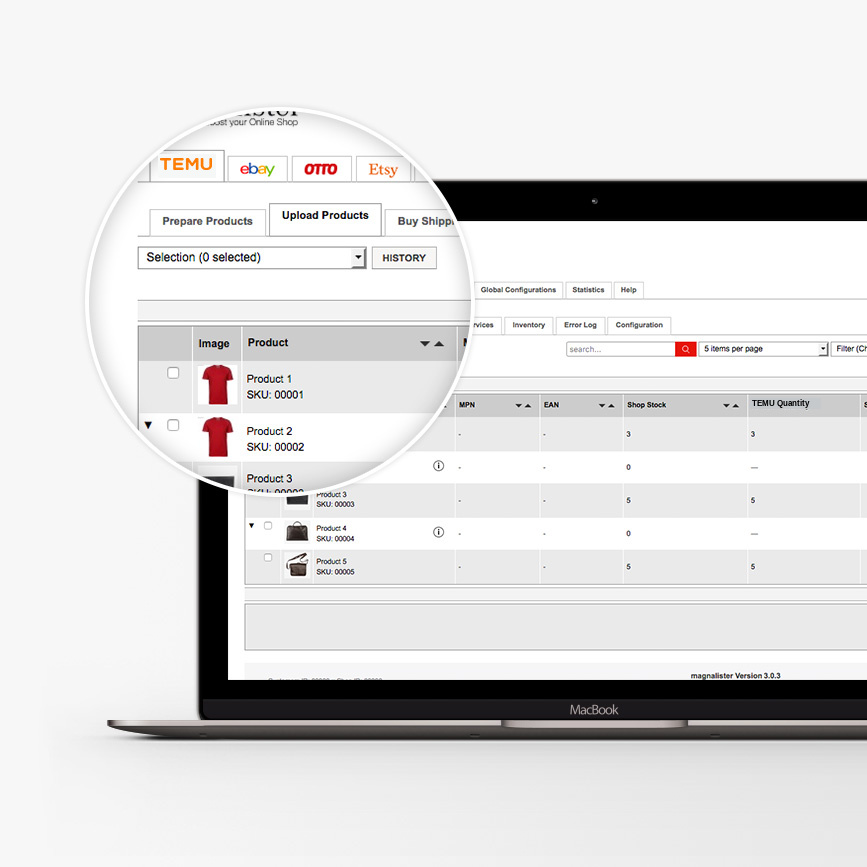
magnalister connects popular shop systems such as Shopify, WooCommerce, Shopware and many more to the leading international marketplaces, including eBay, Amazon, Kaufland and, most recently, Temu. 14
The integration covers the entire lifecycle of a listing and turns your web shop into the central control panel with the following core features:
- Automated product upload: Upload individual items or entire categories directly from your shop back end, including flexible attribute mapping.
- Real-time synchronization: Prices and stock levels are automatically synchronized with Temu whenever they change in your web shop, which reduces out-of-stock phases.
- Pricing rules per marketplace: Use configurable markup or discount rules to control Temu-specific base prices without changing the prices in your own shop.
- Central order import: Temu orders flow directly into your shop system, where you process them as usual.
- Shipping status synchronization: Shipping confirmations and tracking IDs are automatically transmitted to Temu.
Instead of maintaining each listing manually, you manage your product range from the back end you already know. Onboarding for magnalister’s Temu integration is usually completed in under 15 minutes.
Try the Temu integration free for 30 days now
Conclusion: Temu registration is straightforward, but good preparation remains essential
Registration in the Temu Seller Center is free of charge, open to all types of business and can be started in around ten minutes. If you have the required documents (VAT ID, bank details, proof of business registration, proof of address and ID) ready in advance, you will often be approved within one business day.
The Local Seller Program gives you access to a marketplace with around 130 million monthly active users in the EU, 20.9 million of them in Germany alone.
What’s more, because Temu charges no base fees, unlike other marketplaces, getting started is low-risk and predictable even for smaller online merchants.
If you run Temu as part of a multichannel strategy, an integration such as magnalister keeps the operational workload to a minimum, so you can focus fully on your product range and growth.
TRY MAGNALISTER FREE FOR 30 DAYS
FAQ: Becoming a seller on Temu
How do I register as a seller on Temu?
You register through the Temu Seller Center. There, you create a seller account, enter your company and tax details, upload the required documents and add your bank details and shipping information. Registration is free of charge and can be started in just a few minutes 7.
Do I need an invitation to become a seller on Temu?
No. German businesses can now register on their own through the Temu Seller Center. You don’t need an invitation from Temu to sign up for the Local Seller Program. 7
Do I need a warehouse in Germany to sell on Temu?
No. German merchants don’t necessarily have to store their goods in Germany. For the Local Seller Program, however, they need inventory in the EU from which they can deliver to their customers within the required delivery times. 4
Which documents do I need to start selling on Temu?
You need details about your company, business address, tax status and bank account. For verification, Temu requires, depending on your legal form, a trade registration or commercial register extract, proof of address and the ID document of the authorized representative, among other things. For regulated products, safety and conformity documents are also required 7.
How long does it take to get approved as a Temu seller?
According to Temu, the application takes around ten minutes if your documents are complete. Merchants often receive the result of the review within one business day. Around 50% of new sellers make their first sale within 20 days 7.
Who can join the Temu Local Seller Program?
Businesses based in one of the 37 participating markets can join the Local Seller Program. These include Germany, Austria and Switzerland. Which company and tax details you need depends on where your business is based, its legal form and the markets you plan to sell in 4.
Can I sell to other EU countries through Temu?
Yes. Through the Local Seller Program, eligible merchants can also deliver to customers in other EU member states without necessarily operating a warehouse there 4. Whether you need the OSS procedure or a local VAT registration depends on your warehouse location, delivery route and VAT situation 10.
Is selling on Temu worth it for German merchants?
Selling on Temu can pay off if your product range, base price and shipping processes suit the marketplace. Temu’s platform share is already included in the difference between the base price and the retail price. In addition, merchants must factor in their costs for procurement, shipping, returns, compliance and, where applicable, advertising, as well as any separately itemized account charges 1, 7.
Can I connect Temu to my existing online shop?
Yes. With an integration such as magnalister, popular shop systems – including Shopify, Shopware, WooCommerce, PrestaShop, Magento and Gambio – can be connected directly to the Temu Seller Center. Products, prices, stock levels and orders are then managed centrally from your shop back end, so you no longer have to maintain each listing manually.
- 1 Whaleco Technology Limited (Temu) – “DSA Transparency Reports”, H2 2025 report with figures on monthly active users in the EU and in Germany – https://www.temu.com/transparency-center-reports.html – February 2026 (accessed October 7, 2026) ↩︎1.a, ↩︎1.b
- 2 German E-Commerce and Distance Selling Trade Association (bevh) / EHI Retail Institute – “Wachstum im E-Commerce: Lichtblick in der deutschen Wirtschaft”, marketplace share of German online retail in 2025 (in German) – https://bevh.org/detail/wachstum-im-e-commerce-lichtblick-in-der-deutschen-wirtschaft – January 22, 2026 (accessed October 7, 2026) ↩︎
- 3 e-commerce magazin – “Boom von Temu & Co.: Chancen auch für europäische Händler?”, interview with Thorben Bollmann, CEO of PXL Group (premiumXL, Lomado), on Temu’s development in Europe (in German) – https://www.e-commerce-magazin.de/interview-premiumxl-boom-temu-chancen-ecommerce-europa-a-b3c5f6dd81b29e2f7295c7ebb5023cb4/ – March 23, 2026 (accessed October 7, 2026) ↩︎
- 4 Digital Commerce 360 / Temu – “Sell Locally and Now Into Regional Markets: Temu’s Local Seller Program Explained (2026 Update)”, sponsored content on behalf of Temu with information on markets, categories, cross-border selling and getting started – https://www.digitalcommerce360.com/2026/04/30/sell-locally-and-now-into-regional-markets-temus-local-seller-program-explained-2026-update/ – April 30, 2026 (accessed October 7, 2026) ↩︎4.a, ↩︎4.b, ↩︎4.c, ↩︎4.d, ↩︎4.e, ↩︎4.f, ↩︎4.g
- 5 European Union / Your Europe – “CE marking”, requirements, product groups concerned and how the CE marking relates to conformity documentation – https://europa.eu/youreurope/business/product-rules-compliance/general-product-compliance/ce-marking/index_en.htm – n.d. (accessed October 7, 2026) ↩︎5.a, ↩︎5.b
- 6 SELR eCommerce-Magazin – “10 Fragen an Temu: So kannst Du mit Local-to-Local auf Temu verkaufen”, Temu’s answers on the Local-to-Local model for German merchants (in German) – https://www.selr.de/10-fragen-an-temu-so-koennen-deutsche-haendler-auf-temu-verkaufen/ – August 22, 2024, last updated January 30, 2025 (accessed October 7, 2026) ↩︎
- 7 Temu (Whaleco Technology Limited) – “Temu Seller Center EU”, official seller portal with information on registration, processing times, price fields and account-specific terms; partly visible only after login – https://seller-eu.temu.com/ – n.d. (accessed October 7, 2026) ↩︎7.a, ↩︎7.b, ↩︎7.c, ↩︎7.d, ↩︎7.e, ↩︎7.f, ↩︎7.g, ↩︎7.h, ↩︎7.i
- 8 Temu – “Temu Wins Gold Stevie Award for Local Seller Program”, press release on the award for the Local Seller Program – https://www.retaildive.com/press-release/20260205-temu-wins-gold-stevie-award-for-local-seller-program/ – February 9, 2026 (accessed October 7, 2026) ↩︎
- 9 Federal Central Tax Office (BZSt) – “Assignment / Issue of the VAT number”, eligibility and application for a German VAT ID (USt-IdNr.) – https://www.bzst.de/EN/Businesses/VAT/VAT_ID/Assignment/assignment_node.html – n.d. (accessed October 7, 2026) ↩︎
- 10 European Commission – “The One Stop Shop: VAT e-Commerce”, €10,000 threshold and OSS procedure for intra-EU distance sales – https://vat-one-stop-shop.ec.europa.eu/one-stop-shop_en – n.d. (accessed October 7, 2026) ↩︎10.a, ↩︎10.b
- 11 European Commission – “Commission designates Temu as Very Large Online Platform under the Digital Services Act”, Temu’s VLOP designation on May 31, 2024 – https://digital-strategy.ec.europa.eu/en/news/commission-designates-temu-very-large-online-platform-under-digital-services-act – May 31, 2024 (accessed October 7, 2026) ↩︎
- 12 European Commission – “Commission evaluates the Digital Services Act’s interaction with other EU laws and its designation threshold for VLOPs and VLOSEs”, confirmation of the threshold of 45 million average monthly active recipients in the EU for VLOPs and VLOSEs – https://digital-strategy.ec.europa.eu/en/news/commission-evaluates-digital-services-acts-interaction-other-eu-laws-and-its-designation-threshold – November 17, 2025 (accessed October 7, 2026) ↩︎
- 13 European Union – “Regulation (EU) 2022/2065 on a Single Market For Digital Services (Digital Services Act)”, traceability of traders on online marketplaces under Article 30 DSA – https://eur-lex.europa.eu/eli/reg/2022/2065/oj/eng – October 19, 2022 (accessed October 7, 2026) ↩︎
- 14 RedGecko GmbH (magnalister): “magnalister – Easily Get Your Products Into Amazon, eBay and More”, supported shop systems and marketplaces as well as features for product upload, attribute matching, price and inventory synchronization, order import and order status synchronization, accessed October 7, 2026, https://www.magnalister.com/en/ ↩︎