Checklist for German Merchants: Legal Requirements for Selling on Temu
Selling on Temu is subject to the same product safety, consumer protection and tax rules as selling on other major online marketplaces. This guide shows which registrations, labeling requirements and information obligations German merchants need to check before they start selling, including a practical checklist for your launch.
Fact-checked on October 7, 2026 · Editorial team: magnalister
TL;DR: Legal requirements for selling on Temu
- Liability: Temu’s checks do not replace your responsibility as a manufacturer, importer or distributor. Product safety, labeling and tax obligations remain with you.
- Product safety: Every consumer product needs a responsible economic operator established in the EU, whose contact details must appear both on the product and in the listing.
- Registrations: LUCID registration is mandatory for all packaging filled with goods, and a WEEE number for every electrical device. Both must be in place before the products are placed on the market.
- Information obligations: The withdrawal policy and general terms and conditions must reach customers before the contract is concluded. An insert in the parcel comes too late in legal terms.
- Cross-border sales: Once your EU distance sales exceed €10,000, you pay VAT in the country of destination. For imports from non-EU countries, the €150 customs duty exemption was abolished in July 2026.
Table of Contents
Why does Temu vet its sellers so thoroughly?
Temu thoroughly checks its sellers’ company and contact details because Article 30 of the Digital Services Act (DSA) requires online marketplaces to identify traders before admitting them to the platform and to verify certain information 1.
Since May 31, 2024, Temu has also been designated as a Very Large Online Platform (VLOP). As a result, extended obligations apply to the platform, including annual risk assessments, independent audits and semi-annual transparency reports. 2
In return, you benefit from a level playing field for customers and sellers.
Key takeaway: compliance remains your responsibility.
Temu reviews your listings but does not take on the obligations that come with them. Product safety, labeling and tax payments remain your responsibility. Complete and consistent information pays off twice: you meet your obligations and, at the same time, lay the foundation for stable visibility of your listings.
To learn which documents Temu already requires during onboarding, along with other useful information, read our comprehensive guide to selling on Temu.
Selling on Temu: which registrations do you need?
Three key registrations may be relevant for packaging, electrical equipment and batteries before you start selling: LUCID, a WEEE registration and a battery registration. Whether you need them depends on the product, the delivery route and your legal role.
Overview: which registration obligations apply to which products?
| Obligation | When is it required? | Register/authority | Legal basis |
|---|---|---|---|
| LUCID registration | First commercial supply of filled packaging in Germany | ZSVR / LUCID | Art. 44 PPWR, § 6 VerpackDG 3 |
| WEEE registration | Offering electrical and electronic equipment as a producer | stiftung ear | §§ 6, 7 ElektroG 4 |
| Battery registration | First making available of batteries or products containing batteries as a producer | stiftung ear | Batteries Regulation (EU) 2023/1542 5 |
When do you need a LUCID registration to sell on Temu?
If you are the first to supply packaging filled with goods on the German market on a commercial basis, you must register with the LUCID Packaging Register beforehand. If the packaging typically ends up as waste with private final consumers, you must also join a so-called dual system (duales System) for collection and recycling. 3
Marketplaces such as Temu have been legally required to check your LUCID registration since July 1, 2022. Since August 12, 2026, these obligations have been governed by the EU Packaging and Packaging Waste Regulation (PPWR) and the German Packaging Law Implementation Act (VerpackDG), which replaced the previous Packaging Act (VerpackG).
The process involves three steps before you start selling:
- LUCID registration: Free registration in the register of the Central Agency Packaging Register (Zentrale Stelle Verpackungsregister, ZSVR).
- System participation: A paid license agreement with a dual system (e.g., Der Grüne Punkt, Interzero) for your planned annual volumes.
- Data reporting: Entering the licensed volumes in your LUCID account so they can be matched (§ 9 VerpackDG). 3
When do you need a WEEE or battery registration on Temu?
If you qualify as a producer under the Electrical and Electronic Equipment Act (ElektroG), you must register with stiftung ear (Stiftung Elektro-Altgeräte Register) before offering an electrical or electronic device for the first time. Registration is carried out separately for each relevant combination of brand and type of equipment. Once your application has been approved, you receive your WEEE registration number (WEEE-Reg.-Nr. DE), which you must state when offering the devices and on invoices. 4
You need an additional battery registration if, as a producer, you make batteries or products with built-in or enclosed batteries available in Germany for the first time. Simply reselling goods that are already properly registered does not automatically trigger a registration obligation of your own. 5
Without these registrations, Temu is legally required to block the affected listings without delay. Violations can also result in fines of up to €100,000 (§ 45(2) ElektroG) and costly cease-and-desist letters (Abmahnungen) from competitors.
What mandatory information must products and listings on Temu include?

Every consumer product covered by the General Product Safety Regulation (GPSR) must have a responsible economic operator established in the EU. In your Temu listing, you also need to provide manufacturer details, product identification and any required warnings. Depending on the product, CE marking or fiber labeling is also required.
Overview: product and listing information for selling on Temu
| Obligation | Products concerned | Where to provide it | Legal basis |
|---|---|---|---|
| Responsible economic operator | Consumer products covered by the GPSR | Product, packaging, parcel or accompanying documents; for non-EU manufacturers, also the listing | Art. 16, 19 GPSR 6 |
| Manufacturer details, product identification and warnings | Consumer products covered by the GPSR | Listing and, depending on the information, product, packaging or accompanying documents | Art. 19 GPSR 6 |
| CE marking | Products for which EU legislation requires the marking | Generally the product; exceptions under the relevant product legislation | Art. 30 Regulation (EC) No 765/2008 7 |
| Fiber labeling | Textile products covered by EU textile labeling rules | Product and listing | Regulation (EU) No 1007/2011 8 |
GPSR: who is responsible for your Temu product?
The General Product Safety Regulation (GPSR), which has applied since December 13, 2024, requires a responsible economic operator established in the EU for every consumer product it covers. Depending on the case, this operator’s contact details must appear on the product, its packaging, the parcel or an accompanying document. If the manufacturer is based outside the EU, the details must also appear in the online listing. 6
Who acts as the responsible economic operator depends on the supply chain:
- Manufacturer established in the EU: The manufacturer itself is the responsible economic operator.
- Importer: If the manufacturer is not established in the EU, the importer generally assumes responsibility.
- Authorized representative: If the manufacturer is not established in the EU, it can appoint an authorized representative established in the EU in writing to carry out the required tasks.
- Fulfillment service provider in the EU: This provider takes on the role if there is no EU manufacturer, importer or authorized representative appointed accordingly.
Which warnings and manufacturer details do your products need?
Under Art. 19 GPSR, your Temu listing must clearly and visibly include the following information:
- Manufacturer details: name, registered trade name or trademark, postal address and electronic address
- Responsible economic operator: name, postal address and electronic address, if the manufacturer is not established in the EU
- Product identification: a picture of the product and its type, batch or serial number or any other unique identifier
- Warnings and safety information: in a language that consumers in the respective country of destination can easily understand
Which details must also appear physically on the product, the packaging or in the accompanying documents depends on the specific obligation. In the listing, the information required under Art. 19 GPSR must be immediately visible or easily accessible; a general link to your store’s homepage is not sufficient. 6
When do Temu products need CE marking?
Only harmonized products for which the relevant EU legislation expressly requires it need CE marking. By affixing the mark, the manufacturer declares that the product meets the applicable EU requirements.
Explained simply: what are harmonized products?
Harmonized products are goods for which specific EU legislation sets uniform EU-wide safety and health requirements, for example toys, electronic devices, radio equipment or medical devices.
You assess conformity on your own responsibility, prepare the technical documentation including test reports and issue an EU declaration of conformity. You then affix the CE mark to the product so that it is clearly visible. For details on the exact procedure and exceptions (e.g., for high-risk products), see the EU portal on CE marking. 7
What fiber labeling do textile products on Temu need?
Textile products must carry a durable, easily legible and accessible label showing their fiber composition, using the fiber names laid down by law. When selling online, this composition must also be shown in the listing before purchase, in the language required in the respective country of destination. 8
Which buyer information obligations apply on Temu?
As a Temu merchant, you must provide buyers with the following information before the contract is concluded, as required by the distance selling rules of the German Civil Code (BGB) and related legislation 9, 10, 11:
- Withdrawal policy (Widerrufsbelehrung) including the model withdrawal form
- General terms and conditions (AGB) or other standard contract terms
- Legal notice/provider identification (Impressum) (§ 5 of the German Digital Services Act, DDG)
- Complete price information (including unit prices for goods sold by measure, weight or volume)
Please note: The statutory withdrawal button (§ 356a BGB) is usually provided by the marketplace. The withdrawal policy must reach customers before the contract is concluded. An insert in the parcel does not meet this requirement, and if customers are not properly informed, the withdrawal period is extended to up to 12 months and 14 days (§ 356(3) and (4) BGB).
What rules apply to cross-border sales on Temu?
When you sell across the EU or import goods from non-EU countries, two additional sets of rules come into play: EU VAT law for distance sales and customs law.
How do you account for VAT on cross-border sales within the EU?
For cross-border B2C sales within the EU, VAT treatment depends on storage location, delivery route and sales volume. If you ship exclusively from Germany and your EU-wide sales have not exceeded the threshold of €10,000 net in either the current or the previous calendar year, your sales are generally taxed in Germany.
Above this threshold, the VAT rate of the respective country of destination applies. You can also opt for taxation in the country of destination voluntarily. 12
For simplified processing, two voluntary schemes are available:
- EU OSS (One Stop Shop): This scheme lets you declare and pay VAT on covered EU distance sales centrally via the Federal Central Tax Office (BZSt). In many cases, this means you can avoid additional VAT registrations in the countries of destination.
- IOSS (Import One Stop Shop): This scheme is available for B2C consignments shipped directly from non-EU countries with a value of no more than €150 and simplifies the handling of import VAT.
Good to know: invoices and records in Germany and abroad
For B2B supplies, you must issue an invoice within six months that contains all mandatory details (§ 14 of the German VAT Act, UStG). You must keep invoices and accounting records for eight years, starting from the end of the calendar year in which they were created (§ 147 of the German Fiscal Code, AO). Invoices received electronically must also be archived electronically.
Customs law: end of the €150 duty exemption since July 2026
Since July 1, 2026, small consignments worth up to €150 that enter the EU directly from a non-EU country have been subject to a temporary flat customs duty of €3 per item category in the consignment, which is set to apply until July 1, 2028 13.
If you ship from an EU warehouse, this duty is not charged again for each customer order, provided the goods are already in free circulation in the EU. That is a clear cost advantage over direct shipping from China.
We walk through the details in our fee overview for selling on Temu.
What new obligations apply to Temu merchants in 2026 and 2027?
The first additional EU requirements have applied since August 2026, and more will follow through 2027. Which of them affect you depends on your product range and the technologies you use:
| Obligation | What applies? | Since/from when? | Legal basis |
|---|---|---|---|
| AI transparency | Disclosure of AI interactions and certain AI-generated content | August 2, 2026 | EU AI Act, Art. 50 14 |
| Legal guarantee notice and guarantee label | Notice on the legal guarantee; additional label for durability guarantees of more than two years | September 27, 2026 | Dir. (EU) 2024/825, Impl. Reg. (EU) 2025/1960 15 |
| EUDR (EU Deforestation Regulation) | Due diligence obligations for covered products made from wood, coffee, cocoa, rubber and other commodities | December 30, 2026; micro and small enterprises: June 30, 2027 | Regulation (EU) 2023/1115 16 |
What are the most common compliance mistakes on Temu?
Late registrations, incomplete product information and mistakes in cross-border sales are particularly risky. Avoid these five pitfalls to prevent sanctions by the platform:
- Confusing platform checks with liability: Temu checks listings strictly but does not assume legal responsibility. If you violate product safety law, you alone are liable to authorities and to associations that issue cease-and-desist letters.
- Submitting registrations late: Any required LUCID, WEEE and battery registrations must be in place before you offer the products or place them on the market. Registering later does not undo violations already committed.
- Forgetting GPSR contact details in the listing: The online listing must show the manufacturer’s details and, if the manufacturer is based outside the EU, also the details of the responsible economic operator. In each case, this includes a postal address and an electronic address.
- Enclosing the withdrawal policy only with the delivery: This does not meet your pre-contractual information obligations. If customers are not properly informed at all, the withdrawal period is extended to up to 12 months and 14 days, which means returns remain possible for more than a year.
- Ignoring the delivery threshold: If the €10,000 threshold applies to you and you exceed it, the B2C distance sales concerned must generally be taxed in the country of destination. Continuing to pay VAT in Germany can lead to back payments and corrections.
Multichannel selling: why does manual data maintenance increase compliance risk?
With every additional sales channel you run alongside Temu, your manual maintenance effort grows disproportionately, and with it the risk that legally mandatory information such as GPSR contacts or safety notices differs from channel to channel.
The result is often deleted products, account suspensions or even cease-and-desist letters.
This is where magnalister comes in: its multichannel integration transfers product data centrally from your online store to Temu and other marketplaces. With more than 272 million listings and an order volume of more than €10 billion processed, magnalister is one of Europe’s leading multichannel providers.
Automated multichannel selling with Temu and magnalister
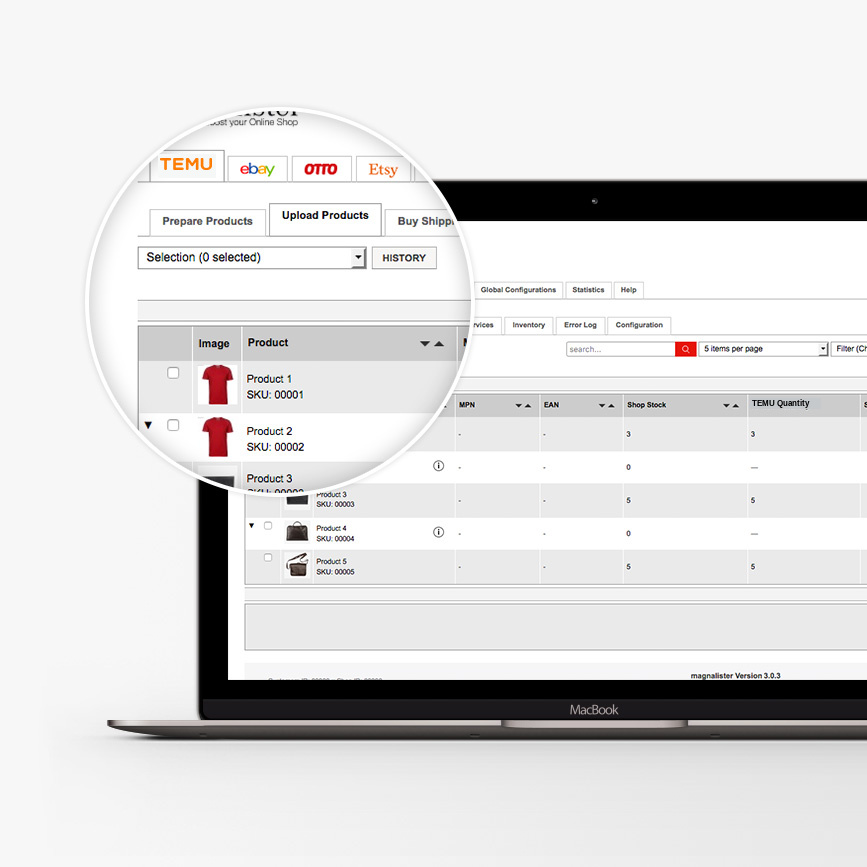
magnalister centralizes your product data directly in your own store system and automatically transfers it to Temu and other marketplaces such as Amazon, eBay or OTTO. 17
This allows you to reach new and diverse target groups effectively while reducing your dependence on individual sales channels.
In addition, the following features make it easier to implement legal requirements across your sales channels:
- Central master data management: You maintain product data once in your store and transfer it automatically, including Temu’s required listing fields and shipping profiles.
- Real-time synchronization: Automatic inventory and price synchronization helps prevent overselling and incorrect delivery time information.
- Risk diversification: Less dependence on individual platforms by diversifying your sales channels.
Start selling on Temu with magnalister now
Conclusion: with good preparation, compliant selling on Temu is straightforward
To sell compliantly on Temu, first clarify which obligations apply to your product range. Depending on the product, these include a responsible economic operator under the GPSR, LUCID registration, a WEEE number and the correct VAT classification.
After you start selling, you need to keep registrations and product information up to date and apply changes across all sales channels. A multichannel integration such as magnalister supports you with central management of your product data.
In addition, new AI transparency obligations have applied since August 2026, and new rules on legal guarantee notices and guarantee labels apply from September 27, 2026.
TRY MAGNALISTER FREE FOR 30 DAYS
Checklist: how to sell compliantly on Temu as a merchant
Before you start selling
- Valid VAT identification number (USt-IdNr.)
- Check the responsible economic operator in the EU
- LUCID registration (ZSVR) and system participation, if applicable
- WEEE number from stiftung ear, if applicable (only for electrical equipment, as a producer)
- Battery registration with stiftung ear, if applicable (battery-powered devices, as a producer)
- EUDR due diligence obligations for commodities, if applicable
Information obligations and required elements of the Temu listing
- Provider identification (Impressum) under § 5 DDG
- Withdrawal policy & model withdrawal form
- Prices including VAT & unit prices, if applicable
- Manufacturer details with postal address and electronic address
- For manufacturers from non-EU countries, also the details of the responsible economic operator
- Product image and unique product identifier
- Warnings and safety information in the language of the country of destination
- Label AI interactions and certain AI-generated content under Art. 50 AI Act
- Legal guarantee notice and, if applicable, guarantee label under the rules applying from September 27, 2026
On the product/packaging
- Manufacturer details under the GPSR
- Details of the responsible economic operator in the EU, if applicable
- Product identification and required warnings and safety notices
- CE marking, if required by EU product legislation
- Fiber labeling for covered textile products
For cross-border sales within the EU
- Check VAT treatment based on the €10,000 threshold
- Use EU OSS for central reporting and payment, if applicable
When importing products from non-EU countries
- Use IOSS for B2C consignments worth up to €150, if applicable
FAQ: Frequently asked questions about legal requirements on Temu
What is the difference between a manufacturer and an importer under the GPSR?
A manufacturer makes a product or has it designed or manufactured and markets it under its own name or trademark. An importer places a product from a non-EU country on the EU market for the first time. Both roles have their own obligations regarding product safety, labeling and documentation; however, an importer does not automatically take on all of the manufacturer’s obligations 6.
Is Temu liable for the products I sell there?
No. In principle, you remain responsible yourself in line with your role. Temu’s obligations as an online marketplace do not replace your product law obligations as a manufacturer, importer or distributor. Among other things, Temu must collect trader information and respond to illegal offers in accordance with the DSA 6.
Do I have to pay customs duty on my products as a Temu merchant?
Yes, if you import goods from non-EU countries and import duties are due on them. Since July 1, 2026, small consignments worth up to €150 have been subject to a flat duty of €3 per item category in the consignment. If the goods are already in free circulation in the EU, no further import duty is due when you ship from an EU warehouse 13.
Which registrations do I need before I can sell on Temu?
That depends on your product type and legal role. For packaging, you need a LUCID registration and, where applicable, system participation 3. For electrical equipment or batteries, a WEEE number or battery registration with stiftung ear may also be required 4, 5.
Which taxes apply when selling on Temu?
Sales on Temu are generally subject to VAT. For cross-border B2C sales within the EU, the common EU-wide threshold of €10,000 applies. If the sales are taxable in the country of destination, you can use the EU OSS scheme for central reporting and payment 12.
Do I also have to include warnings in the Temu listing?
Yes, if warnings or safety information are required for the product. They must already be clearly visible in the online listing. The listing must also include manufacturer details and product identification. If the manufacturer is based outside the EU, the contact details of the responsible economic operator in the EU are also required 6.
Do all products on Temu need CE marking?
No. CE marking is only mandatory for product groups covered by the relevant EU legislation. These include, for example, toys, certain electrical equipment, radio equipment and medical devices. Products without a CE marking obligation must not bear the mark 7.
- 1 European Union: “Regulation (EU) 2022/2065 on a Single Market For Digital Services (Digital Services Act)”, trader verification under Art. 30 DSA, accessed October 7, 2026, https://eur-lex.europa.eu/eli/reg/2022/2065/oj/eng ↩︎
- 2 European Commission: “Commission designates Temu as Very Large Online Platform under the Digital Services Act”, Temu’s designation as a VLOP and the resulting obligations, accessed October 7, 2026, https://digital-strategy.ec.europa.eu/en/news/commission-designates-temu-very-large-online-platform-under-digital-services-act ↩︎
- 3 Central Agency Packaging Register (ZSVR): “Mail order companies and online retailers – what will change under the PPWR?”, LUCID registration, system participation, data reporting and due diligence obligations of online platforms under the PPWR, accessed October 7, 2026, https://www.verpackungsregister.org/en/knowledge-bases/mail-order-companies-and-online-retailers ↩︎3.a, ↩︎3.b, ↩︎3.c, ↩︎3.d
- 4 Stiftung Elektro-Altgeräte Register (stiftung ear): “Applying for WEEE-registration”, requirements, procedure and use of the WEEE-Reg.-Nr. DE, accessed October 7, 2026, https://www.stiftung-ear.de/en/guides/applying-for-weee-registration/ ↩︎4.a, ↩︎4.b, ↩︎4.c
- 5 German Environment Agency (Umweltbundesamt): “Batterieverordnung: UBA aktualisiert Beleihung der stiftung ear”, registration obligations under the EU Batteries Regulation (in German), accessed October 7, 2026, https://www.umweltbundesamt.de/themen/batterieverordnung-uba-aktualisiert-beleihung-der ↩︎5.a, ↩︎5.b, ↩︎5.c
- 6 European Union: “Regulation (EU) 2023/988 on general product safety”, obligations of economic operators and information required in online listings under the GPSR, accessed October 7, 2026, https://eur-lex.europa.eu/eli/reg/2023/988/oj/eng ↩︎6.a, ↩︎6.b, ↩︎6.c, ↩︎6.d, ↩︎6.e, ↩︎6.f, ↩︎6.g
- 7 European Commission: “CE marking – obtaining the certificate, EU requirements”, product groups concerned and manufacturers’ obligations, accessed October 7, 2026, https://europa.eu/youreurope/business/product-rules-compliance/general-product-compliance/ce-marking/index_en.htm ↩︎7.a, ↩︎7.b, ↩︎7.c
- 8 European Union: “Regulation (EU) No 1007/2011 on textile fibre names and related labelling and marking of the fibre composition of textile products”, labeling requirements for textile products, accessed October 7, 2026, https://eur-lex.europa.eu/legal-content/EN/TXT/?uri=CELEX:32011R1007 ↩︎8.a, ↩︎8.b
- 9 Federal Ministry of Justice and Consumer Protection: “German Civil Code BGB”, information and withdrawal obligations in distance selling under §§ 312d, 355 and 356 BGB (English translation, status 2021), accessed October 7, 2026, https://www.gesetze-im-internet.de/englisch_bgb/ ↩︎
- 10 Federal Ministry of Justice and Consumer Protection: “Digitale-Dienste-Gesetz”, provider identification under § 5 DDG (in German, no English translation available), accessed October 7, 2026, https://www.gesetze-im-internet.de/ddg/__5.html ↩︎
- 11 Federal Ministry of Justice and Consumer Protection: “Preisangabenverordnung”, total price and unit price information for consumers (in German, no English translation available), accessed October 7, 2026, https://www.gesetze-im-internet.de/pangv_2022/ ↩︎
- 12 European Commission: “The One Stop Shop”, EU-wide threshold and the OSS and IOSS schemes for cross-border B2C sales, accessed October 7, 2026, https://vat-one-stop-shop.ec.europa.eu/one-stop-shop_en ↩︎12.a, ↩︎12.b
- 13 Council of the European Union: “EU action on the influx of small parcels”, flat customs duty of €3 per item category for small consignments worth up to €150, accessed October 7, 2026, https://www.consilium.europa.eu/en/policies/eu-action-influx-of-small-parcels/ ↩︎13.a, ↩︎13.b
- 14 European Union: “Regulation (EU) 2024/1689 laying down harmonised rules on artificial intelligence (Artificial Intelligence Act)”, transparency obligations under Art. 50 AI Act, accessed October 7, 2026, https://eur-lex.europa.eu/eli/reg/2024/1689/oj/eng ↩︎
- 15 European Union: “Directive (EU) 2024/825 amending Directives 2005/29/EC and 2011/83/EU as regards empowering consumers for the green transition through better protection against unfair practices and through better information”, legal guarantee notice and guarantee label from September 27, 2026, accessed October 7, 2026, https://eur-lex.europa.eu/legal-content/EN/ALL/?uri=CELEX:32024L0825 ↩︎
- 16 European Commission: “Regulation on Deforestation-free products”, product scope and application dates of the EU Deforestation Regulation, accessed October 7, 2026, https://environment.ec.europa.eu/topics/forests/deforestation/regulation-deforestation-free-products_en ↩︎
- 17 RedGecko GmbH (magnalister): “magnalister – Easily Get Your Products Into Amazon, eBay and More”, supported shop systems and marketplaces as well as features for product upload, attribute matching, price and inventory synchronization, order import and order status synchronization, accessed October 7, 2026, https://www.magnalister.com/en/ ↩︎